


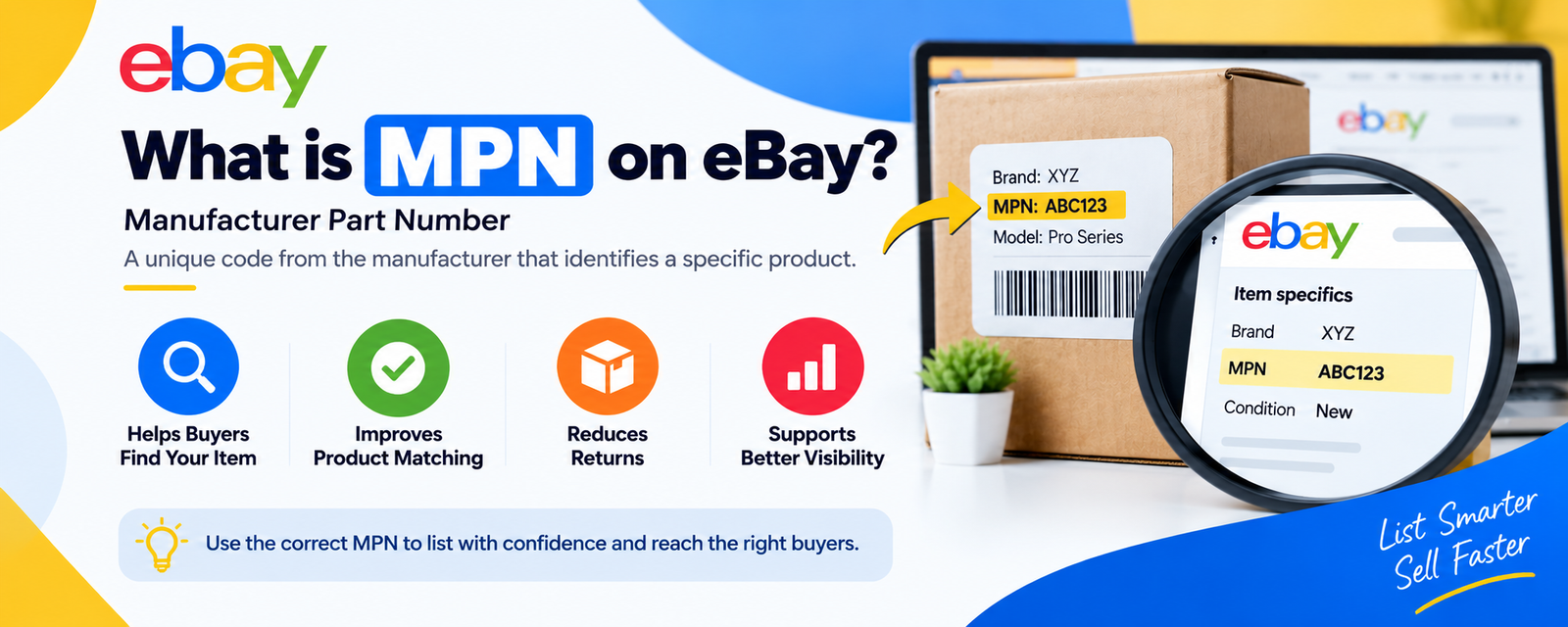
What is MPN on eBay? MPN stands for Manufacturer Part Number. It is a code the manufacturer gives to one specific product or part. eBay uses your MPN, along with brand and GTIN, to match your listing to the right catalog page in its Cassini search engine. A correct MPN helps buyers find your item, cuts down on returns, and can improve your search ranking. A wrong or missing MPN does the opposite.
If you sell electronics, auto parts, tools, or branded accessories, this field matters. It is one of the fastest fixes you can make on an existing listing.
What Does MPN Mean on eBay?
MPN is short for Manufacturer Part Number. The manufacturer creates this code to identify one exact product or replacement part. eBay does not assign it, and you should not invent one.
Think of a printer cartridge. Two cartridges can look almost identical but fit different printer models. The MPN tells eBay’s system, and the buyer, which one is which.
eBay pulls the MPN into your item specifics section. From there, Cassini (eBay’s search and ranking system) uses it to:
- Match your listing to the correct catalog entry
- Group your item with identical listings from other sellers for price comparison
- Show buyers product reviews and specs next to your listing
- Judge how complete your listing data is, which affects visibility
Buyers searching directly in Google for a part number is common in auto parts and electronics. If your listing does not carry the correct MPN in the right field, that buyer will not find you, no matter how good your title is.
MPN vs UPC vs GTIN vs SKU vs EAN vs ASIN
These identifiers get mixed up often. Here is the difference in one table.
| Identifier | Who assigns it | Unique to one seller? | Used on |
|---|---|---|---|
| MPN | Manufacturer | No, shared by every seller of that part | eBay, Amazon, Google Shopping |
| UPC | GS1 (barcode authority), via the brand owner | No, shared | eBay, Amazon, Google Shopping (US-focused) |
| GTIN | GS1, umbrella term covering UPC, EAN, ISBN | No, shared | Global; eBay and Google Shopping both ask for “GTIN” |
| EAN | GS1 | No, shared | Mostly UK/EU marketplaces |
| SKU | You, the seller | Yes, internal only | Your own inventory system, never shown to buyers |
| ASIN | Amazon | No, one per catalog listing | Amazon only |
In short: GTIN, UPC, and EAN are barcode numbers. MPN is the manufacturer’s own code, used when a product has no barcode or to reinforce the barcode. SKU is yours alone and never goes on the marketplace.
Why MPN Matters for eBay Sellers
- Search visibility. Cassini treats complete product identifiers as a trust signal. Listings missing MPN, brand, or UPC tend to rank behind listings that have all three filled in correctly.
- Fewer returns. Buyers get the exact part, not a close match. This matters most for auto parts, electronics, and anything with model-specific compatibility.
- Product-page matching. eBay builds comparison pages (new, used, and aftermarket) around a correct MPN. Land on one of these and you get exposure you did not have to fight for in the title.
- Fewer disputes. Accurate identifiers mean fewer buyer messages asking if an item fits their model, before or after the sale.
Which eBay Categories Actually Require MPN?
MPN is not mandatory everywhere. eBay enforces it on categories where product-specific matching matters most.
| Category type | MPN requirement |
|---|---|
| Business & Industrial, Cameras & Photo, Cell Phones & Accessories, Computers/Tablets & Networking, Consumer Electronics, Musical Instruments & Gear, Sporting Goods | Required |
| Clothing, Shoes & Accessories, Crafts, Health & Beauty, Tickets & Experiences, Pet Supplies | Optional |
| Handmade, vintage, or private-label items with no manufacturer code | Not applicable, use “Does Not Apply” |
Check eBay’s own product identifiers reference for the current category list before you bulk-edit listings. eBay updates this table from time to time.
Where to Find the Correct MPN
Check these sources in order:
- Product packaging or the printed label. Usually next to or below the barcode.
- The part itself. Many auto and electronics parts have it stamped or engraved.
- The manufacturer’s website or support page. Searchable by model.
- Your supplier’s product feed, CSV export, or invoice. Useful if you dropship or source wholesale.
- The item’s manual or spec sheet.
If the product has variants (color, size, storage capacity), check whether each variant carries its own MPN. Apparel is the common exception, since sizes often share one MPN. Electronics variants almost always get separate codes.
When “Does Not Apply” Is Fine, and When It Hurts You
“Does Not Apply” exists for a real reason. It is correct when:
- The item is handmade or private label with no manufacturer code
- The product is genuinely vintage or one of a kind
- You have checked packaging, the manufacturer’s site, and your supplier, and no MPN exists
It becomes a problem when sellers use it as a shortcut on branded, catalog-listed products that do have an MPN. eBay reads that as incomplete data, and incomplete data ranks lower.
Note for multi-market sellers: the text you enter changes by eBay site. If you list across regions, use the correct local string, not a direct translation.
| eBay site | “Does Not Apply” text |
|---|---|
| US, UK, Canada (English), Australia, Ireland | Does not apply |
| Germany, Austria, Switzerland | Nicht zutreffend |
| France, Belgium (French) | Non applicable |
| Italy | Non applicabile |
| Netherlands, Belgium (Dutch) | Niet van toepassing |
| Spain | No aplicable |
Getting this string wrong on a non-English site causes the same incomplete-listing problem as leaving the field blank.
Common MPN Mistakes That Quietly Hurt Rankings
| Mistake | Why it hurts you |
|---|---|
| Entering a UPC or SKU in the MPN field | Marketplaces reject or flag this as invalid data |
| Defaulting to “Does Not Apply” on branded products | Signals incomplete data, lowers visibility |
| Reusing one MPN across different variants | Breaks product matching, causes wrong-item complaints |
| Putting the MPN only in the title, not the MPN field | Google can index it, but eBay’s catalog matching still fails |
| Copying an MPN from a similar but different product | Leads to buyer complaints and possible listing suppression |
| Never auditing older listings | Legacy listings quietly underperform new ones with complete data |
MPN on Amazon and Google Shopping: Quick Comparison
MPN rules are not identical across platforms.
- Amazon: MPN is optional in most categories, but recommended wherever GTIN exemptions apply or buyers search by part number. If the product already exists in Amazon’s catalog, the code often carries over automatically.
- Google Shopping (Google Merchant Center): MPN is required only when the product has no manufacturer-assigned GTIN. It is optional for custom or handmade goods. See Google’s official MPN guidance for exact formatting rules.
- eBay: Required in specific categories (see the table above), optional elsewhere, “Does Not Apply” for genuinely identifier-free products.
The identifier itself does not change between platforms. A real MPN is the same code everywhere. What changes is whether each platform requires it and how strictly it enforces the rule.
Managing MPN Across Multiple Sales Channels
Confirming the right MPN once is only step one. Sellers then have to enter it correctly on eBay, Amazon, and their Google Shopping feed, and keep all three in sync when a supplier changes a part number.
A multichannel platform like Stockkonnect pulls product identifiers into one central catalog, then pushes the correct MPN, brand, and GTIN to every connected channel automatically:
- One correct MPN entry, synced everywhere, with no copy-paste across seller dashboards
- Fewer “Does Not Apply” defaults, because missing fields get flagged before a listing goes live
- Consistent data across eBay, Amazon, and Google Shopping, which reduces suppressed or rejected listings
Explore Multichannel Listing · eBay Integration · Inventory & Catalog Sync
FAQ
What is MPN on eBay in simple terms?
It’s the code a manufacturer gives one exact product or part. eBay uses it to match your listing to the right catalog entry.
Is MPN the same as SKU on eBay?
No. SKU is your own internal stock code and stays private. MPN is public, manufacturer-issued, and shared by every seller of that part.
Is MPN the same as UPC?
No. UPC is a barcode number issued through GS1. MPN is the manufacturer’s own part number and can exist even when there’s no barcode.
Can I leave eBay MPN blank?
No. If the category requires it, an empty field usually blocks the listing or gets auto-filled with “Does Not Apply,” which can hurt ranking on branded items.
What if my product genuinely has no MPN?
Select “Does Not Apply.” That’s correct for handmade, vintage, or private-label items. Confirm first that no manufacturer code actually exists.
Where can I find the MPN for my product?
Check the packaging, the part itself, the manufacturer’s website, or your supplier’s product feed, in that order.
Does MPN affect eBay search ranking?
Yes. Cassini treats complete product identifiers as a data-quality signal, and complete listings tend to outrank listings with missing fields.