


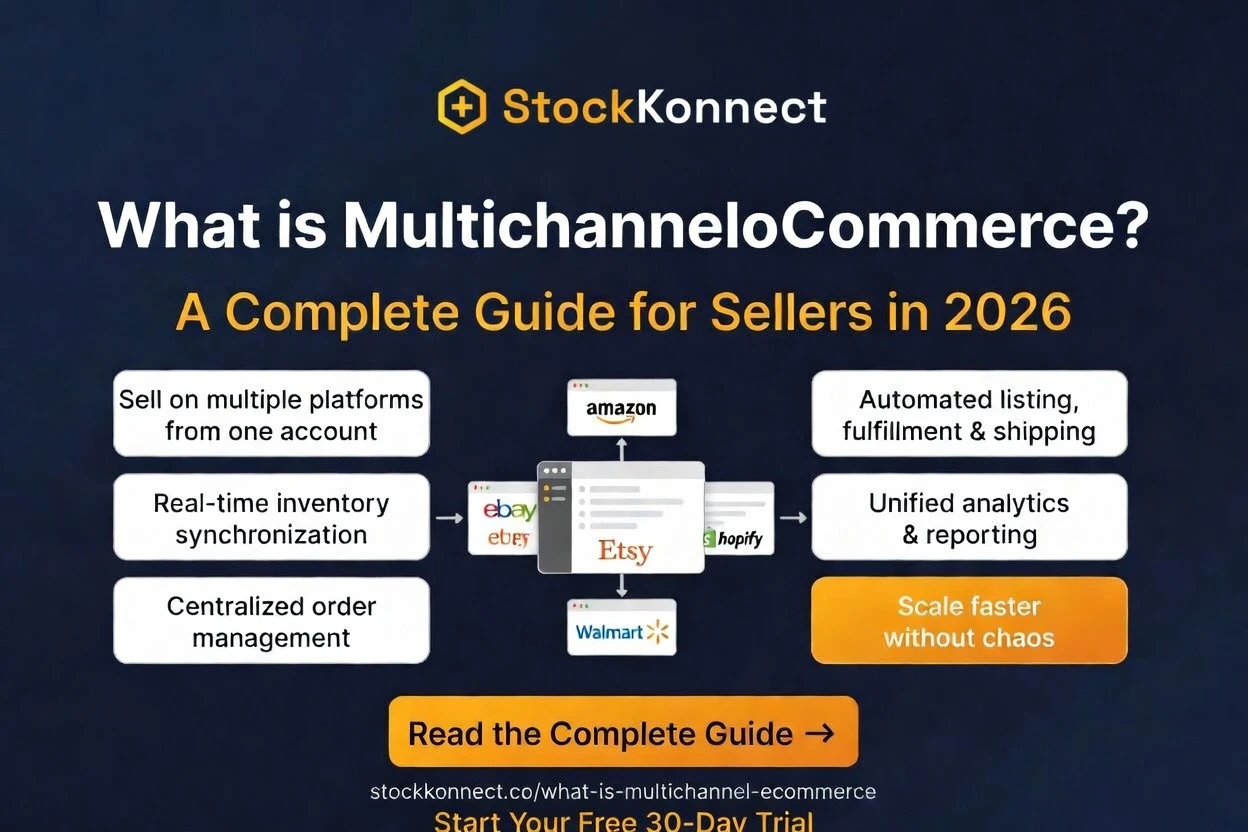
The most successful eCommerce businesses in 2026 no longer rely on a single marketplace or sales channel. Instead, they operate across multiple ecommerce platforms such as Amazon, eBay, Shopify, Walmart, Etsy, and WooCommerce to increase product visibility, reach more customers, diversify revenue streams, and build a more scalable multichannel ecommerce operation.
Table of Contents
ToggleThis strategy is known as multichannel ecommerce. By selling across multiple marketplaces simultaneously, businesses can reduce platform dependency, improve customer reach, and create a more resilient ecommerce infrastructure. However, as operations scale, managing inventory synchronization, product listings, order workflows, fulfillment processes, and marketplace integrations manually becomes increasingly complex.
In this complete guide, we cover everything you need to know about multichannel ecommerce, including how it works, why it matters, which sales channels to prioritize, the operational challenges sellers face, and how ecommerce automation software can help centralize inventory management, streamline order processing, synchronize listings, and manage multichannel operations more efficiently from a single dashboard.
What Is Multichannel Ecommerce?
Multichannel ecommerce is the practice of selling products across multiple online marketplaces and sales channels simultaneously – including platforms such as Amazon, eBay, Shopify, Etsy, Walmart, and WooCommerce – instead of relying on a single ecommerce platform or marketplace for all sales activity.
Each connected sales channel creates an additional revenue opportunity, expands product visibility, and increases customer reach across different marketplaces. The goal of multichannel ecommerce is to allow businesses to meet customers wherever they prefer to shop while managing inventory synchronization, product listings, order management, and marketplace integrations more efficiently through centralized ecommerce operations and automation systems.
A multichannel seller might, for example:
- List products on Amazon to reach Prime-loyal shoppers
- List the same products on eBay to reach bargain hunters and collectible buyers
- Run a Shopify store for direct-to-consumer brand building
- Sell on Etsy to reach craft and handmade enthusiasts
- Expand to Walmart Marketplace to access its 120 million+ monthly US visitors
All of this happens in parallel, with a centralised inventory and order management system keeping everything synchronised behind the scenes.
Single-Channel vs Multichannel Selling: A Direct Comparison
To understand the value of multichannel ecommerce, it helps to see how it compares directly to single-channel selling:
| Single-Channel Selling | Multichannel Selling |
|---|---|
| Revenue limited to one audience | Access to multiple buyer pools |
| High platform dependency risk | Revenue diversified across channels |
| Vulnerable to algorithm changes | Resilient to single-platform disruption |
| Easier to manage manually | Requires inventory sync software |
| Lower growth ceiling | Significantly higher revenue potential |
| Simpler fee structure | Multiple fee structures to manage |
The data consistently supports multichannel selling. Research shows that multichannel retailers generate an average of 38% more revenue than single-channel sellers, and customers who engage with a brand across multiple channels have a 30% higher lifetime value.
The Most Important Ecommerce Channels in 2026
Not all channels are right for every seller. Here’s an overview of the key ecommerce platforms and what each is best suited for:
| Channel | Best For | Monthly Visitors | Seller Type |
|---|---|---|---|
| Amazon | Branded & general products | 2.7 billion+ | All sizes |
| eBay | New, used & collectibles | 1.7 billion+ | All sizes |
| Shopify | Own branded store | Your own traffic | SMB to enterprise |
| Etsy | Handmade & vintage | ~500 million | Small & independent |
| Walmart | General merchandise (US) | 120 million+ | Mid to large |
| WooCommerce | WordPress-based own store | Your own traffic | SMB |
Stock Konnect integrates with all six of these channels, allowing you to manage your entire multichannel operation from one platform.
7 Key Benefits of Multichannel Ecommerce
1. Significantly Higher Revenue
The most immediate benefit of multichannel selling is increased revenue. Each additional channel you add is a new audience of potential buyers who might never have found you on your primary platform. More channels equals more sales opportunities, equals more revenue.
2. Reduced Business Risk
Sellers who rely on a single platform are one algorithm change, fee increase, or account suspension away from losing their entire income. Multichannel selling distributes your revenue across multiple platforms, so no single event can bring your business down overnight.
3. Access to Different Buyer Audiences
Different platforms attract fundamentally different buyer profiles. Amazon buyers skew towards brand-conscious, convenience-driven shoppers. eBay attracts bargain hunters and collectors. Etsy appeals to those seeking unique, handmade items. Multichannel selling lets you capture all of these audiences simultaneously.
4. Increased Brand Visibility
The more places your products appear online, the more recognisable your brand becomes. Buyers who see your products on multiple platforms are more likely to trust your brand and return directly to your own store (such as Shopify or WooCommerce) for future purchases.
5. Better Inventory Utilisation
With single-channel selling, slow-moving stock on one platform sits idle. Multichannel selling exposes the same inventory to multiple audiences, increasing the chance of a product finding its buyer and reducing the cost of carrying unsold stock.
6. Seasonal Revenue Smoothing
Different platforms have different peak periods. By selling across multiple channels, your revenue is less dependent on any single platform’s seasonal traffic patterns. A slow month on one channel may be offset by strong performance on another.
7. Competitive Advantage
The majority of small eCommerce sellers still operate on a single channel. By going multichannel, you immediately differentiate yourself from competitors and access audiences they are not reaching. This is a significant structural advantage that compounds over time.
The Challenges of Multichannel Ecommerce (And How to Overcome Them)
Challenge 1: Inventory Management Across Channels
The biggest operational challenge of multichannel selling is keeping inventory accurate across every platform simultaneously. If the same item sells on Amazon and eBay at the same time but your stock hasn’t updated, you have an oversell on your hands.
Solution: Use a multichannel inventory management tool with real-time sync. Stock Konnect automatically updates stock levels across all connected channels the instant any sale is made eliminating the overselling risk entirely.
Challenge 2: Managing Listings Across Multiple Platforms
Creating and maintaining listings on multiple platforms separately is incredibly time-consuming. Each platform has different listing requirements, image specifications, and category structures.
Solution: Use a multichannel listing management software like Stock Konnect to create product listings once and push them to all connected channels simultaneously. Updates to titles, prices, or descriptions can be made centrally and pushed to all platforms in one action.
Challenge 3: Order Management from Multiple Sources
When orders arrive from five different platforms, keeping track of what needs to be picked, packed, and shipped without missing anything is a significant operational challenge.
Solution: A centralised order management system consolidates all orders from all channels into one dashboard. Stock Konnect shows every pending order from Amazon, eBay, Shopify, Etsy, Walmart, and WooCommerce in one place, with bulk processing and shipping tools built in.
Challenge 4: Different Platform Policies and Fee Structures
Every platform has its own rules, listing policies, and fee structures. Managing compliance and profitability across multiple channels requires careful tracking.
Solution: Learn each platform’s core policies before listing. Use Stock Konnect’s reporting tools to track profitability by channel, factoring in platform fees, so you always know where your margins are healthiest.
Multichannel vs Omnichannel Ecommerce: What’s the Difference?
These two terms are often used interchangeably, but they mean different things:
- Multichannel ecommerce means selling across multiple independent channels. Each channel operates somewhat separately you manage inventory and orders centrally, but each platform provides its own distinct buyer experience.
- Omnichannel ecommerce takes multichannel a step further by creating a fully unified, seamless customer experience across all touchpoints online and offline. The customer journey is consistent whether they shop on Amazon, your Shopify store, or a physical retail location.
For most eCommerce sellers, multichannel is the right starting point. Omnichannel is a more advanced strategy typically pursued by larger retailers with physical store presence. Multichannel gives you the revenue and audience benefits without the complexity of full omnichannel integration.
How to Get Started with Multichannel Ecommerce
- Start with your strongest channel: Optimise your presence on your primary platform before expanding. A strong foundation makes multichannel scaling much smoother.
- Choose your second channel strategically: Pick a channel whose audience complements your existing one. Amazon sellers often expand to eBay first. Etsy sellers often expand to eBay or Shopify.
- Connect a multichannel management platform: Before going live on multiple channels, set up your centralised inventory and order management system. This is non-negotiable trying to manage two or more channels manually is a recipe for errors.
- Enable real-time inventory sync: Activate stock synchronisation across all connected channels so inventory is always accurate, everywhere, in real time.
- Optimise listings for each platform: Each channel has its own algorithm and buyer expectations. Tailor your titles, descriptions, and images to each platform while maintaining consistent product quality and branding.
- Monitor, measure, and expand: Use reporting tools to track performance by channel. Double down on what’s working and continue adding channels as your operations allow.
How Stock Konnect Powers Multichannel Ecommerce
Stock Konnect is a UK-based multichannel ecommerce platform built specifically to help sellers manage Amazon, eBay, Shopify, WooCommerce, Walmart, and Etsy from one powerful dashboard.
- Multichannel listing management: Create listings once and publish to all connected channels simultaneously.
- Real-time inventory sync: Stock levels update instantly across all channels the moment any sale is made.
- Unified order management: Every order from every channel in one dashboard, with bulk processing and shipping.
- Shipping automation: Bulk label printing, carrier integrations, and parcel tracking all built in.
- Performance reporting: Cross-channel analytics to track revenue, order volumes, and inventory health.
- Dropshipping support: Connect supplier feeds and manage dropship operations across all channels.
- 30-day free trial: The longest free trial of any multichannel platform on the market no credit card required.
Frequently Asked Questions
1. What is an example of multichannel ecommerce?
A seller who lists the same product on Amazon, eBay, and their own Shopify store simultaneously is practising multichannel ecommerce. They use a tool like Stock Konnect to keep inventory synchronised across all three channels and manage all orders from one dashboard.
2. Is multichannel ecommerce worth it for small businesses?
Absolutely. Small businesses often benefit most from multichannel selling because it dramatically expands their reach without requiring large capital investment. With the right multichannel software handling the operational complexity, even a one-person business can sell across multiple platforms efficiently.
3. What is the biggest risk of multichannel ecommerce?
The biggest risk is overselling taking more orders than you have stock to fulfil because inventory hasn’t updated across all channels quickly enough. This risk is completely eliminated with real-time inventory synchronisation software like Stock Konnect.
4.How many channels should I sell on?
Start with two or three channels and expand from there as your operations allow. Most successful multichannel sellers begin with Amazon and eBay, then add Shopify for brand building, followed by Etsy, Walmart, and WooCommerce as their business scales.
5.What software do I need for multichannel ecommerce?
You need a multichannel management platform that handles listing, inventory sync, order management, and shipping across all your channels. Stock Konnect is one of the most comprehensive and affordable options available, supporting Amazon, eBay, Shopify, WooCommerce, Walmart, and Etsy from a single dashboard with a 30-day free trial to get started.
Ready to Go Multichannel? Start with Stock Konnect
Multichannel ecommerce is not the future it is the present. The sellers growing fastest in 2026 are the ones reaching buyers across Amazon, eBay, Shopify, Etsy, Walmart, and WooCommerce simultaneously. And with Stock Konnect, managing all of those channels is no harder than managing one.
Real-time inventory sync. Unified centralized order management. Bulk listing creation. Shipping automation. Comprehensive reporting. Everything you need to run a successful multichannel ecommerce business all in one platform.
Start your 30-day free trial today. No credit card required.