


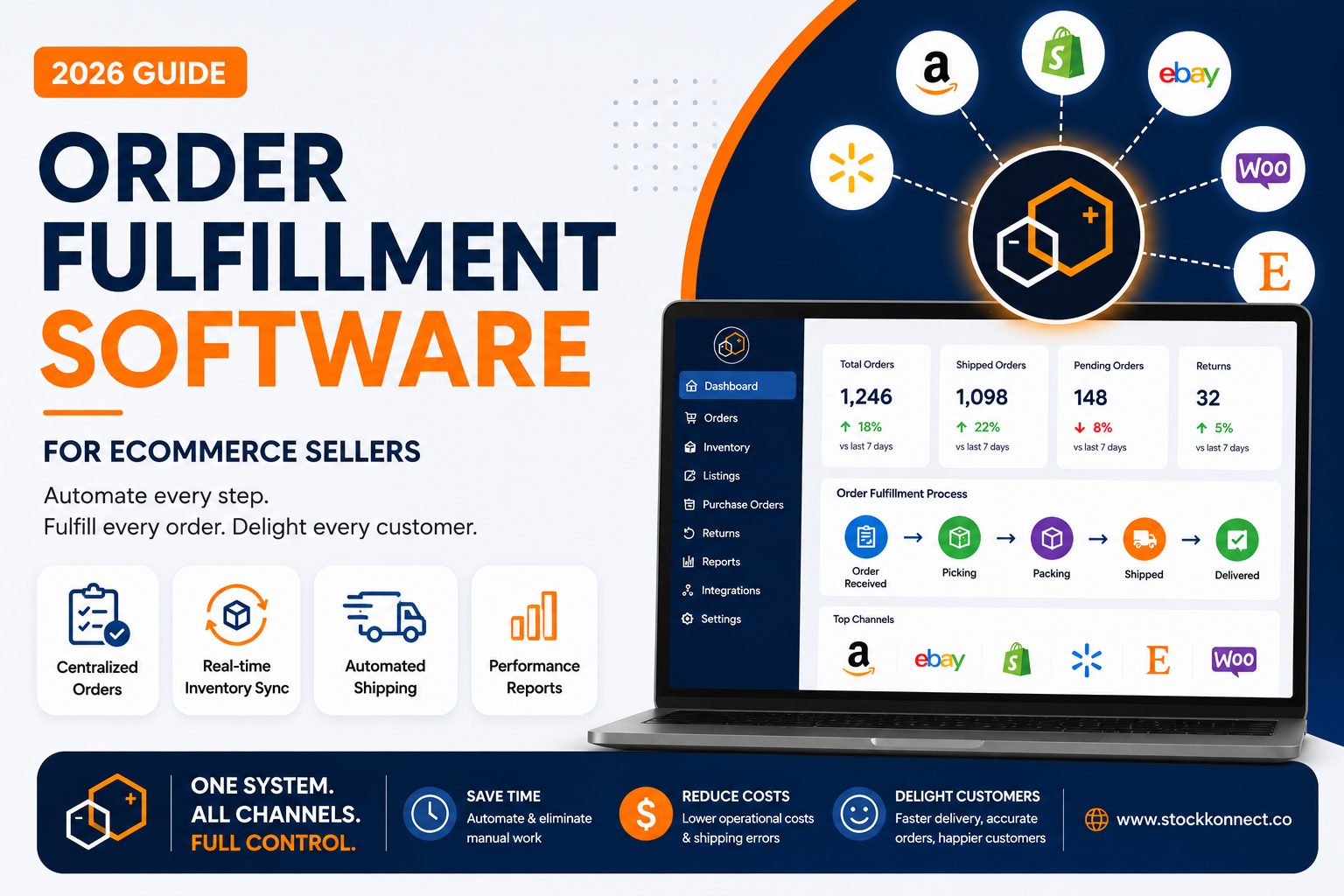
Slow or inconsistent order fulfillment doesn’t just frustrate customers after checkout, it costs sales before checkout even completes. For multichannel sellers, the challenge is bigger than shipping a package quickly: it’s making sure every order, from every channel, is fulfilled against the same accurate stock count, without manual reconciliation between platforms.
What is order fulfillment software?
Order fulfillment software is a system that automates the process of receiving, processing, picking, packing, and shipping customer orders. For ecommerce sellers, it typically includes centralized order data across every sales channel, automated packing slip generation, shipping carrier integration, and returns management, so orders move from “placed” to “delivered” without manual handling at each step.
Why Order Fulfillment Software Matters in 2026
Fulfillment problems show up earlier in the buying journey than most sellers realize. The average ecommerce cart abandonment rate sits at 70.22%, based on the Baymard Institute’s meta-analysis of 50 separate studies. Of the documented reasons shoppers abandon a cart, 48% cite extra costs revealed at checkout, largely shipping fees, and 21% cite slow delivery timelines as a direct factor. Fulfillment isn’t just a backend operations problem, it’s directly tied to whether a sale completes in the first place.
For sellers running more than one sales channel, the stakes compound further. An order placed on Amazon, a return processed through Shopify, and a shipping label generated for an eBay sale all need to reference the same underlying order and stock data, otherwise fulfillment errors and mismatched inventory counts follow close behind. For the mechanics of how this connects to inventory specifically, see our complete guide to ecommerce inventory management.
What is the difference between order management and order fulfillment?
Order management is the broader system that tracks an order from the moment it’s placed through to completion, including inventory allocation, payment, and customer communication. Ecommerce Order fulfillment is the physical and logistical part of that process, picking, packing, and shipping the actual product. Order management software often includes fulfillment as one component, rather than the two being fully separate systems.
The Order Fulfillment Process, Step by Step
Every fulfillment operation, regardless of scale, moves through the same core stages. Understanding each one makes it easier to see exactly where software removes manual work.
| Step | What Happens | Where Delays Typically Occur |
| 1. Order Received | A customer places an order on any connected sales channel | Manual re-entry between marketplace dashboards |
| 2. Order Validated | Stock is checked against the order to confirm it can be fulfilled | Inventory counts out of sync across channels |
| 3. Picking | Items are located and retrieved from storage | No clear picking list or SKU location data |
| 4. Packing | Items are packed and a shipping label is generated | Manual label creation per carrier |
| 5. Shipping | The package is handed to the carrier and tracking begins | Carrier integration gaps, no automated tracking updates |
| 6. Delivery Confirmation | The customer receives the order and tracking closes out | No automated post-shipment notification |
| 7. Returns (if applicable) | A returned item is received, inspected, and restocked | Stock not updated automatically after a return |
What are the 5 steps of the order fulfillment process?
The five core steps of order fulfillment are receiving and validating the order, picking the items from storage, packing the order with a generated shipping label, shipping the package to the carrier, and confirming delivery. A seventh step, processing returns, applies whenever an item comes back and needs to be inspected and restocked.
What Good Order Fulfillment Software Actually Does
Regardless of business size, a genuinely useful order fulfillment system covers the same core ground:
- Centralizes order data across every connected sales channel into one dashboard, rather than switching between separate marketplace seller portals to fulfill each order individually
- Automatically imports new orders the moment they’re placed, no manual re-entry
- Ties fulfillment to real-time inventory, so an order is never confirmed against stock that isn’t actually available
- Generates shipping labels and packing slips automatically, cutting manual packing station time
- Handles returns as part of the same system, adjusting stock automatically rather than requiring a separate manual step
- Reports on fulfillment performance, so bottlenecks are visible before they become customer complaints
This is where StockKonnect’s approach differs from a lot of the category: fulfillment isn’t a bolt-on module, it’s connected directly to the same real-time inventory and listing data across Amazon, eBay, Shopify, Walmart Marketplace, Etsy, and WooCommerce, with direct courier integrations including Royal Mail and DHL. A restocked item from a purchase order template is ready to fulfill the moment it arrives, without a separate sync step between systems.
What are the benefits of order fulfillment software?
Order fulfillment software reduces manual order entry, prevents overselling by connecting fulfillment to live inventory data, speeds up shipping label and packing slip generation, centralizes order data across every sales channel, and surfaces performance data that’s otherwise invisible when fulfillment is handled manually.
Different Types of Order Fulfillment Approaches
Not every seller needs the same setup. The table below breaks down the four main models by how they actually operate.
| Model | How It Works | Control Level | Cost Structure | Best Fit |
| In-house fulfillment with connected software | Seller picks, packs, and ships orders themselves; software centralizes order data and syncs stock across channels | High | Flat/scalable software cost + owned storage and labor | Sellers who want full control and are managing 2+ channels |
| Outsourced fulfillment (3PL) | A third-party logistics provider handles physical storage, picking, packing, and shipping | Low to medium | Storage + per-order fulfillment fees, scales with volume | Sellers who’d rather not manage warehouse space or staffing |
| Marketplace-native fulfillment | Programs like Fulfillment by Amazon (FBA) handle fulfillment for orders on that specific marketplace only | Low | Per-order marketplace fee | Single-channel sellers on one marketplace |
| Enterprise ERP-integrated fulfillment | Fulfillment runs as one module inside a larger ERP or CRM system | High, but complex | Implementation cost + ongoing licensing | Large, multi-entity organizations |
A seller running two or more channels is the point where marketplace-native fulfillment (like FBA-only) starts to create a fragmented picture, since each program only sees its own orders. That’s typically the trigger to move toward either in-house fulfillment with connected software, or a 3PL relationship that can unify shipping across all channels.
How do I choose the right order fulfillment software?
Choosing the right order fulfillment approach depends on sales channel count, whether fulfillment is handled in-house or outsourced, shipping carrier requirements, return volume, and budget. Multichannel sellers managing their own fulfillment should prioritize tools with native marketplace integrations and transparent, order-volume-based pricing, while sellers wanting to fully outsource physical fulfillment should weigh a 3PL relationship instead of software alone.
Key Order Fulfillment KPIs to Track
Once fulfillment software is in place, these are the metrics that actually show whether it’s working. Industry benchmarks are included below so results can be measured against real standards, not guesswork.
| KPI | What It Measures | Industry Benchmark | Source |
| Order Accuracy Rate | % of orders shipped with correct items and quantities | 99.5%-99.9% is the standard for well-run operations; best-in-class hits 99.8% | ShipDudes; NetSuite |
| Fulfillment Rate | % of orders successfully processed, packed, and delivered in full and on time | A healthy range is 97%-99% | FieldAssist |
| Perfect Order Rate | Orders delivered on time, complete, damage-free, with accurate documentation | 90%+ is considered excellent across most industries | MetricHQ |
| Cost Per Error | Cost to resolve a single inaccurate order (returns, replacement, support labor) | $15-$50 per error, depending on complexity | ShipDudes |
| Return Processing Time | Time from return received to stock updated | Delays here directly risk overselling the same item to another customer | Operational best practice |
Tracking these consistently is only possible when order and inventory data live in one system. Trying to calculate order accuracy or return processing time across three separate marketplace dashboards manually is exactly the kind of reconciliation work centralized fulfillment software removes.
Common Order Fulfillment Mistakes
- Treating each sales channel as a separate fulfillment operation — leads to inconsistent packing standards, shipping costs, and delivery timelines depending on where the order came from
- Not updating stock immediately after a return — creates the exact same oversell risk as a delayed sale, just from the opposite direction
- Choosing a shipping carrier without checking actual delivery performance in the target region — a carrier that works well domestically may perform poorly for international orders
- Ignoring fulfillment KPIs until a problem becomes visible to customers — accuracy rate and fulfillment time issues are usually detectable in the data well before they show up as complaints or bad reviews
- Underestimating the cost of manual reconciliation — the time spent manually checking stock across channels before confirming an order is a real, ongoing labor cost, even if it doesn’t appear as a line item
What Order Fulfillment Actually Costs
Fulfillment cost isn’t just the shipping label. A full picture includes:
| Cost Component | What It Covers | Why It’s Often Underestimated |
| Storage | Warehouse space, shelving, or 3PL storage fees | Charged whether or not stock is actively selling, ties up cash in slow-moving inventory |
| Labor | Picking, packing, and quality checking time | The largest ongoing cost in most manual fulfillment operations, and the first to scale unpredictably during peak periods |
| Packaging Materials | Boxes, mailers, void fill, labels | Easy to underprice per-order, but compounds fast at volume |
| Shipping/Carrier Fees | The actual cost to move the package to the customer | Varies significantly by carrier, weight, region, and whether rates are negotiated at volume |
| Error Resolution | Cost of pick-and-pack mistakes | Each inaccurate order can cost $15-$50 to resolve once returns, replacements, and support labor are factored in, per ShipDudes’ 2026 benchmarking data |
| Returns Processing | Labor and restocking cost for returned items | Often tracked separately from “normal” fulfillment cost, understating the true cost per order |
Sellers evaluating whether to bring fulfillment in-house or use a 3PL should weigh all six components, not just the shipping fee, since labor and reconciliation time are often the largest hidden cost in a manual, unconnected fulfillment process.
How to Choose the Right Order Fulfillment Software
Number of Sales Channels
The more channels a business fulfills orders from, the more critical centralized order data becomes. See what multichannel ecommerce actually means for the operational reality behind this.
Shipping Carrier Requirements
Confirm a tool integrates natively with the specific carriers actually used, Royal Mail and DHL for UK sellers, USPS/UPS/FedEx for US-based operations, rather than assuming broad “carrier integration” covers every specific need.
Returns Volume and Complexity
High-return categories (apparel, footwear) need returns tightly connected to live inventory. A return that doesn’t immediately update stock creates the same oversell risk as a delayed sale.
Budget and Pricing Transparency
Some platforms in this category require a sales call before revealing any pricing. A tool with published, order-volume-based pricing is easier to budget against from day one, StockKonnect’s pricing, for example, is published directly on-site and includes a free plan for sellers processing under 40 orders per month.
Decision Checklist
| Question | If Yes | If No |
| Selling on 2+ channels? | Prioritize centralized, real-time sync software | A single marketplace’s native fulfillment program may be sufficient |
| Managing fulfillment in-house? | Look for software with strong carrier and inventory integration | Consider a 3PL relationship instead |
| High return volume? | Confirm returns update stock automatically | Basic returns handling may be enough |
| Need published, transparent pricing? | Filter out quote-only enterprise platforms | Enterprise ERP options become viable |
How Order Fulfillment Connects to Inventory and Listing Management
Fulfillment doesn’t operate in isolation. A sale that’s fulfilled but not reflected back to inventory management creates a false stock count the moment the next order comes in. Similarly, listing accuracy across channels depends on fulfillment data flowing back correctly, an item that’s out of stock after fulfillment needs its listings updated everywhere it’s sold, not just on the channel the last order came from.
This is the core reasoning behind treating fulfillment, inventory, and listing management as one connected system rather than three separate tools that need to be manually kept in sync. For sellers evaluating inventory software specifically, see our guide to inventory management software options for the broader picture.
Frequently Asked Questions
What is order fulfillment software?
Order fulfillment software automates the process of receiving, processing, picking, packing, and shipping customer orders, typically including centralized order data, shipping label generation, and returns management across every connected sales channel.
What is the difference between a CRM and order fulfillment software?
A CRM manages customer relationships, communication history, and sales pipeline data. Order fulfillment software manages the physical and logistical process of getting a placed order to the customer. Some larger platforms connect both, but they solve fundamentally different problems.
How will an order fulfillment solution help my business?
An order fulfillment solution reduces manual order processing time, prevents overselling by tying fulfillment directly to live inventory counts, and centralizes order data across every sales channel, which becomes increasingly important as a business adds more marketplaces or storefronts.
Does order fulfillment software integrate with Amazon and eBay?
Most dedicated ecommerce order fulfillment tools integrate natively with Amazon and eBay. StockKonnect connects order fulfillment directly to inventory sync across both marketplaces, along with Shopify, Walmart Marketplace, Etsy, and WooCommerce, from a single dashboard.
What is the difference between order management and order fulfillment?
Order management is the broader system tracking an order from placement through completion, including inventory allocation and customer communication. Order fulfillment is specifically the physical process, picking, packing, and shipping. See our full explanation of order management systems for more detail.
What KPIs should I track for order fulfillment?
The most important order fulfillment KPIs are order accuracy rate (industry benchmark 99.5%-99.9%), fulfillment rate (healthy range 97%-99%), perfect order rate (90%+ considered excellent), cost per error, and return processing time. Together these reveal whether fulfillment is genuinely connected to inventory or running as a separate, manually reconciled process.
How much does order fulfillment cost?
Order fulfillment cost includes storage, labor, packaging materials, carrier shipping fees, error resolution, and returns processing. The shipping label itself is often only one part of the true cost, a single inaccurate order can cost $15-$50 to resolve once returns, replacements, and support labor are factored in, and labor is typically the largest ongoing cost in a manual, unconnected fulfillment process.
References
- Baymard Institute — Cart Abandonment Rate Statistics (2026 meta-analysis of 50 studies)
- ShipDudes — 3PL Performance Benchmarking: Fulfillment Industry Standards (2026)
- NetSuite — Key Order Fulfillment KPIs Explained
- FieldAssist — Order Fulfillment Rate (OFR): Calculation, KPIs & Strategies (2026)
- MetricHQ — Perfect Order Rate (POR)
Figures above reflect industry-wide benchmarks at time of publication and should be reverified periodically as fulfillment industry data updates.
Getting Started
For multichannel sellers managing their own fulfillment, the priority is a system where order data, inventory, and listings all update from the same source, rather than three separate tools requiring manual reconciliation. Explore StockKonnect’s order management software to see how fulfillment connects to the rest of your operation.