


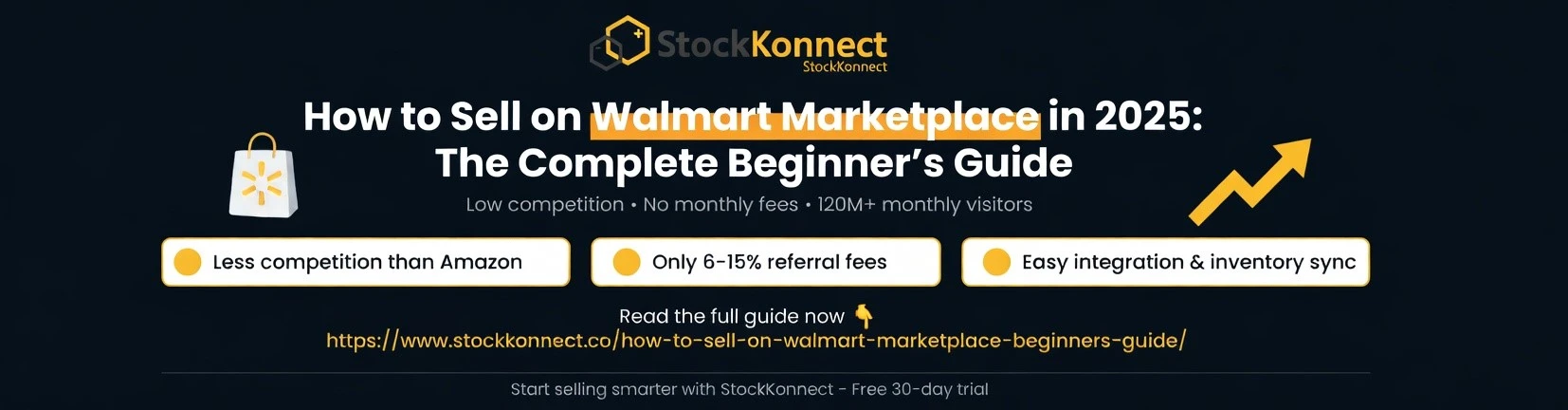
When most ecommerce businesses think about expanding beyond Amazon and eBay, Walmart Marketplace is often overlooked. That creates a major opportunity for sellers using marketplace integration software, inventory management systems, and multichannel ecommerce strategies to scale across additional sales channels with less competition.
Walmart Marketplace has become one of the fastest-growing ecommerce marketplaces in the US, attracting more than 120 million monthly visitors while remaining significantly less saturated than Amazon. For multichannel sellers, this creates a strong opportunity to increase product visibility, diversify revenue streams, and manage marketplace operations more efficiently.
In this complete guide, we’ll explain how to start selling on Walmart Marketplace in 2026, including seller onboarding, listing management, inventory synchronization, multichannel order management, and how ecommerce automation software helps businesses manage Walmart alongside Amazon, eBay, Shopify, and other marketplaces from one centralized dashboard.
What Is Walmart Marketplace?
Walmart Marketplace is Walmart’s third-party ecommerce platform that allows businesses to list and sell products directly on Walmart.com. Similar to Amazon, it helps sellers reach millions of online shoppers while managing listings, inventory, pricing, and orders through centralized ecommerce operations. For multichannel ecommerce businesses, Walmart Marketplace has become an important sales channel alongside Amazon, eBay, and Shopify. Many sellers use marketplace integration software and inventory synchronization tools to manage Walmart operations efficiently and prevent overselling across multiple platforms. Key facts about Walmart Marketplace:- Over 120 million monthly visitors to Walmart.com
- More than 150,000 active third-party sellers (vs. millions on Amazon)
- No monthly subscription fee — you only pay a referral fee per sale
- Access to Walmart’s fulfilment network (Walmart Fulfilment Services / WFS)
- Rapidly growing — Walmart eCommerce revenue has grown over 20% year-on-year
Why Should You Sell on Walmart Marketplace?
There are several compelling reasons to add Walmart to your multichannel selling strategy:1. Less Competition Than Amazon
Amazon has millions of third-party sellers. Walmart Marketplace has around 150,000. This means your products are far more likely to rank on the first page of Walmart search results, especially in less competitive categories.2. No Monthly Subscription Fee
Unlike Amazon, which charges a monthly Professional Seller fee, Walmart Marketplace has no subscription fee. You only pay a referral fee (typically 6–15%) when you make a sale. This makes it a low-risk channel to add to your business.3. Trust and Brand Recognition
Walmart is one of the most trusted retail brands in the world. Selling on Walmart.com immediately lends credibility to your products and can influence buyers who might be hesitant to purchase from an unknown brand on a lesser-known platform.4. Diverse Customer Base
Walmart’s shoppers are different from Amazon’s. They tend to be value-focused, and many are loyal Walmart customers who shop exclusively on Walmart.com. By selling on Walmart, you access an entirely different audience that you’d miss by being Amazon-only.How to Apply to Sell on Walmart Marketplace
Unlike Amazon, Walmart Marketplace has an application process. Not every seller is approved. Here’s what you’ll need:Eligibility Requirements
- A US Business Tax ID (EIN) — individual SSNs are not accepted
- A US business address (or a verified US-based fulfilment operation)
- A proven history of eCommerce selling (Amazon, eBay, or your own store)
- Product catalogue with GTINs/UPCs for each item
- The ability to fulfil US orders reliably
Step-by-Step Application Process
- Visit marketplace.walmart.com and click “Request to Sell”.
- Complete the application form with your business details, tax information, and product catalogue information.
- Wait for approval: Walmart typically reviews applications within 1–2 weeks.
- Set up your Seller Centre account once approved — add your business info, payment details, and shipping settings.
- List your first products either manually through Walmart Seller Centre or via a multichannel listing tool like Stock Konnect.
How to List Products on Walmart Marketplace
Once your account is set up, it’s time to list your products. There are three main ways to do this:Option 1: Manual Listing via Walmart Seller Centre
You can add products one by one through Walmart’s Seller Centre. This works for small catalogues but becomes time-consuming as you scale. Each listing requires a product title, description, images, price, and GTIN/UPC.Option 2: Bulk Upload via Spreadsheet
Walmart provides bulk upload templates that allow you to list hundreds of products at once using a spreadsheet. This is faster but still requires manual data preparation and is prone to formatting errors.Option 3: Use a Multichannel Listing Tool (Recommended)
The most efficient way to list on Walmart — especially if you’re already selling on Amazon or eBay — is to use a multichannel listing tool like Stock Konnect. You can push your existing product catalogue directly to Walmart without re-entering any data, keep inventory synchronised in real time, and manage all your Walmart orders alongside your other channels from one dashboard.How to Optimise Your Walmart Listings for Search
Walmart has its own search algorithm (similar to Amazon’s A9). Here’s how to optimise your listings to rank higher on Walmart.com:Write Keyword-Rich Product Titles
Your product title is the most important ranking factor. Include your primary keyword, brand name, key features, and size/colour/variant information. Keep titles between 50–75 characters for best results.Use High-Quality Images
Walmart requires a minimum of one image at 1000×1000 pixels. Use multiple angles, lifestyle shots, and infographic-style images that show product features. High image quality directly impacts conversion rates.Price Competitively
Walmart’s algorithm heavily favours competitive pricing. If your price is higher than the same product listed elsewhere (including Amazon), Walmart may suppress your listing. Use a pricing strategy that keeps you competitive across all channels.Complete All Product Attributes
Walmart gives listings a ‘Content Quality Score’. The more product attributes you fill in (material, dimensions, age group, brand, etc.), the higher your score and the better your search visibility.Gather Reviews Early
Walmart’s Pro Seller Badge (similar to Amazon’s Prime badge) is partly determined by seller rating and reviews. Encourage satisfied customers to leave reviews and respond professionally to any negative feedback.Managing Walmart Inventory Alongside Amazon and eBay
One of the biggest challenges of adding Walmart to your selling mix is keeping inventory in sync. If you sell the same product on Amazon, eBay, and Walmart, you need stock levels to update across all three channels the moment a sale is made on any of them. This is where Stock Konnect comes in. Stock Konnect connects all your channels — including Walmart — under one roof:- Real-time stock sync: A Walmart sale instantly updates stock on Amazon, eBay, and all other channels.
- Unified order management: View and process Walmart orders alongside all your other orders in one dashboard.
- Bulk listing: Push your existing product catalogue to Walmart in minutes, not days.
- Shipping labels: Print Walmart shipping labels alongside eBay and Amazon labels from the same screen.
Walmart Marketplace Fees Explained
Understanding Walmart’s fee structure is essential before you start selling. Here’s a breakdown:- Monthly subscription fee: Walmart does not charge a monthly fee to sell on its marketplace.
- Referral fees: Range from 6% to 15% depending on the product category. Similar to Amazon’s referral fee structure.
- Walmart Fulfilment Services (WFS): If you use WFS (Walmart’s equivalent of Amazon FBA), fulfilment fees apply based on product size and weight.
- No listing fees: You can list as many products as you like without paying per-listing fees.
Common Mistakes New Walmart Sellers Make (And How to Avoid Them)
- Ignoring the Content Quality Score: Incomplete listings get buried in search results. Fill in every attribute Walmart asks for.
- Not syncing inventory: Managing Walmart stock separately from your other channels is a recipe for overselling. Use a tool like Stock Konnect to automate this.
- Pricing too high: Walmart’s algorithm can suppress listings that are priced higher than other online retailers. Monitor your prices regularly.
- Slow shipping times: Walmart expects fast, reliable fulfilment. Slow shipping damages your seller metrics and can result in listing suppression.
- Not applying for the Pro Seller Badge: The Pro Seller Badge increases click-through rates significantly. Work towards meeting Walmart’s seller performance criteria to earn it.